
Grade Calculator
Calculating your grade should not feel like solving a puzzle. Whether you are tracking your progress mid-semester, figuring out what you need on your final exam, or just trying to understand where you stand in a class, this grade calculator does the heavy lifting for you.
I built this tool because I remember spending hours with a spreadsheet every semester, manually adding up assignment scores and trying to figure out my weighted grade. It was tedious, and I would make mistakes. This calculator handles all the math for you, weighted categories, different grading scales, multiple grading schemes, everything you need in one place.
The grade calculator works for any course structure, traditional points-based grading, weighted categories like 40% homework, 30% tests, 30% final, letter grades, or even international systems like ECTS or UK classifications. Just enter your grades as you go, and it will show you exactly where you stand.
How to Use this Grade Calculator
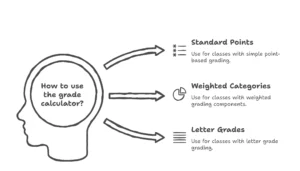
Standard Points-Based Grading
If your class uses simple points like “you have earned 450 out of 500 points so far”, here is how it works:
- Add a category: Give it a name like “All Assignments” and choose “Points” as the type.
- Enter your scores: For each assignment, quiz, or test, add the points you earned and the points possible.
- See your grade: The calculator automatically displays your percentage and letter grade.
Example: You scored 45/50 on Quiz 1, 88/100 on Test 1, and 92/100 on Essay 1. Enter these three items, and you will see your current grade is 225/250 = 90% (A-).
Weighted Categories
Most college courses use weighted grading. Homework counts for 30%, tests for 40%, and the final exam for 30%.
Here is the process
- Create a category for each component: “Homework,” “Tests,” “Final Exam,” etc.
- Set the weight: If homework is worth 30% of your grade, enter 30 in the weight field.
- Add items to each category: Individual assignments go under homework, individual tests under tests.
- Watch it calculate: Your overall grade updates as you add items.
Example: Your syllabus says homework = 40%, tests = 35%, final = 25%. You have completed all homework with an average of 92%, taken two tests with scores of 88% and 94%, but have not taken the final yet. The calculator shows your current grade is 90.3% based on the work you have completed. Later, you can use the “What do I need on my final?” feature to see what score you need on that last exam.
Letter Grades
Some classes, especially humanities courses, assign letter grades rather than numerical scores. Select “Letter A–F” as the category type, and you can enter your grades as letters. The calculator converts them to percentages using standard conversion scales.
You can even customize the conversion thresholds if your professor uses a different scale. They may give an A for anything above 92% rather than 93%. Just adjust the settings.
What Makes This Grade Calculator Different
It Shows You the Breakdown
The “Category breakdown” table shows exactly how each component of your grade contributes to your overall score. This is incredibly helpful when you are trying to decide where to focus your effort. If you see that your test average is dragging down your overall grade while your homework average is perfect, you know to spend more time studying for tests.
What Grade Do I Need?
What Grade Do I Need: is the most used feature, especially during finals week. Enter your current grade, how much your final is worth, and what grade you want to end up with. It will calculate exactly what you need to score on the final exam.
Real scenario: You have an 88% going into the final, the final is worth 30% of your grade, and you want an A 90%. The calculator indicates you need a 93.3% on the final. Is that realistic? Maybe. Is it impossible? No. Now you can make an informed decision about how to study.
Sometimes it will tell you that you need 110% on the final to get your desired grade. That means it is mathematically impossible with your current grade and the final’s weight. In that case, you know to adjust your goal or talk to your professor about extra credit opportunities.
Multiple Grading Systems
The calculator supports US letter grades A–F, UK classifications First, 2:1, 2:2, Third, ECTS grades A–F, and Australian grades HD, D, CR, P, NN. If you are an international student or taking a course that uses a different grading system, you are covered.
Common Ways Students Use This Grade Calculator
The Weekly Check-In
Many students submit their grades each week as assignments that are returned. It is like checking your bank account balance. You want to know where you stand. It prevents end-of-semester surprises.
Typical workflow: On Monday, you receive your quiz back with a score of 16/20. Tuesday, your essay is graded A-. On Wednesday, you bombed a homework assignment 12/15. You enter all three into the calculator and see that you are still at 87%. Not as high as you would like, but you have time to improve before the midterm.
The “Can I Skip This?” Calculator
Let’s be honest: sometimes you wonder whether you can skip an assignment and still maintain your grade. The calculator can help you make that decision mathematically, though I am not recommending you skip work!
Scenario: You have a 94% in the class. There is one more homework assignment worth 2% of your total grade. If you skip it, you score a 0; you would drop to 92%, still an A. If you are completely overwhelmed with other classes and this is not your major, you may want to make that strategic choice. The calculator gives you the information you need to make a decision.
The Finals Week Emergency
During finals week, everyone wants to know: “What do I need on this exam to pass?” or “to get a B?” or “to maintain my A?” This is when the “What do I need on my final?” feature is most heavily used.
True story: A student in my study group had an 82% going into a final that was worth 40% of the grade. She needed an overall score of 85 to keep her scholarship. The calculator showed she needed an 89% on the final, challenging but doable. She studied accordingly and delivered.
The Grade Dispute Tool
Sometimes professors make mistakes when entering grades. If your grade looks wrong on the syllabus, you can use this calculator to verify it yourself. Enter all your scores exactly as they appear, set the weights according to the syllabus, and compare your calculation to the professor’s. If there is a discrepancy, you have grounds to discuss it.
Understanding Weighted Grading: Why It Matters
Most students understand the concept of weighted grades, but many do not fully grasp how they work mathematically. This trips people up when they are trying to figure out their grade.
The Math Behind It
If homework is worth 30% of your grade and you have a 95% homework average, that contributes 28.5 points to your final grade: 95 × 0.30 = 28.5. If tests are worth 50% and you have an 84% test average, that is 42 points: 84 × 0.50 = 42. Add them up: 28.5 + 42 = 70.5% so far, but you have not taken the final yet, which is worth 20%.
This is why you cannot simply average all your assignment percentages. A 100% on a homework assignment worth 2% of your grade is not the same as a 100% on a test worth 15% of your grade.
Why Professors Use Weighted Grading
Different types of work test different skills. Homework measures daily understanding. Tests measure retention and application, projects measure synthesis and creativity. Professors weigh them differently because they value these skills differently in the context of the course.
In a math class, tests might be worth 70% because solving problems under timed conditions is central to math competency. In a writing class, essays might be worth 60% because producing polished written work is the core skill. The weighting reflects the learning objectives.
The Category Average vs. the Overall Average Confusion
Here is where students get confused: if you have an A 95% in homework, a B 85% in tests, and homework is worth more, why isn’t your overall grade an A?
Because weighting is proportional, if homework is 40% and tests are 60%, tests carry more weight. Your overall grade is 95 × 0.40 + 85 × 0.60 = 38 + 51 = 89%, which is typically a B+.
The calculator’s category breakdown table makes this crystal clear. You can see exactly how many points each category is contributing.
Common Grading Scales And How to Adjust Them
Different institutions use different grading scales. Here are the most common:
Standard US Scale (Most Common)
- A: 90 to100% (4.0 GPA)
- B: 80 to 89% (3.0 GPA)
- C: 70 to79% (2.0 GPA)
- D: 60 to 69% (1.0 GPA)
- F: Below 60% (0.0 GPA)
Strict US Scale Used by Some High Schools
- A: 93 to100%
- B: 85 to 92%
- C: 77 to 84%
- D: 70 to 76%
- F: Below 70%
Plus/Minus Scale Common in College
- A+: 97 to100% (4.0)
- A: 93 to 96% (4.0)
- A-: 90 to 92% (3.7)
- B+: 87 to 89% (3.3)
- B: 83 to 86% (3.0)
- B-: 80 to 82% (2.7)
And so on. The calculator defaults to a plus/minus scale, but you can adjust the thresholds under “Advanced options” → “Edit thresholds.”
Why This Matters
If your professor uses a strict 93% for an A and you are sitting at 92.8%, that is the difference between an A and a B. Knowing your exact percentage helps you decide if it is worth asking about rounding or doing extra credit.
Tips for Tracking Your Grade All Semester
1. Enter Grades as You Get Them
Do not wait until the midterm to check your grade. Add each assignment, quiz, and test as it is returned. This gives you a running tally of where you stand.
Why this works: You can catch problems early. If you get a C on the first test, you know you need to adjust your study strategy before the second test.
2. Verify Against the Syllabus
Make sure the weights you have entered in the calculator match the syllabus exactly. Professors sometimes adjust weights mid-semester, so check for announcements.
Common mistake: Assuming the final is worth 20% when it is actually 25%. That 5% difference can significantly affect your “what do I need” calculation.
3. Account for Dropped Grades
Many professors drop your lowest homework score or quiz score. The calculator does not automatically drop scores because it does not know which policy your professor uses, so you will need to exclude dropped assignments manually.
How to handle this: Do not add the dropped assignment to the calculator. If your professor has not decided which score to drop yet, calculate both scenarios, one with the low score included, one without, to see your best and worst possible grades.
4. Use It for “What If” Scenarios
Before a big test, calculate what happens if you get different scores. What if you get a 70%? An 80%? A 90%? This helps you understand how much the test matters and how much pressure you should feel.
Example: You are at an 88%. The upcoming test is worth 15% of your final grade. If you get a 70%, you drop to 85.3%. If you get a 90%, you climb to 88.3%. The test matters, but it is not make-or-break. This relieves some anxiety.
5. Double-Check After Every Exam Period
After midterms and before finals, recalculate everything. Make sure you have not missed any scores and that all weights remain accurate.
Frequently Asked Questions: Grade Calculator
How accurate is this grade calculator?
It is as accurate as the information you enter. The math is straightforward: weighted averages and percentage calculations. If you enter your scores and weights correctly, the result is exact.
The most common “accuracy” issues stem from user error: forgetting to add an assignment, entering the wrong weight, or failing to account for dropped grades. Double-check your inputs.
Can I use this for curved grades?
If your professor curves grades, you will need to know the curve method. Some professors curve by adding points to everyone’s score. If the highest score was 88/100, add 12 points to everyone. Others use a statistical curve.
For a simple add-points curve, add those points to your scores before entering them. For statistical curves, you will need to know your curved score before using the calculator.
We also have a dedicated grade curve calculator if your professor uses bell curve or other curving methods.
What if my grade is mathematically impossible?
Sometimes the “what I need on my final” calculator will tell you that you need more than 100% on the final to achieve your desired grade. This means it is impossible with the current weights.
Your options:
- Adjust your goal, aim for a B instead of an A
- Ask about extra credit
- Talk to your professor about your situation
- Make sure the final weight is correct. Sometimes finals are worth more than you think.
Why does my grade not match the professor’s?
A few common reasons:
- Dropped grades: Your professor dropped a low score; you did not account for that
- Extra credit: The professor included extra credit points that you forgot
- Different weights: You entered the wrong weight for a category
- Participation or attendance: Some professors include participation as a separate grade component
- Calculation error on the professor’s end: It happens. Politely ask them to verify.
Can I share my grade with my study group?
Yes! Use the “Share” button under Advanced options. You can copy a link that preserves all the data you entered. When your study group opens it, they will see your exact setup and can modify it for their own use.
Privacy note: Only share the link with people you trust, as it contains your grade information.
Does this work on mobile?
Yes, the calculator is fully mobile-responsive. Most students use it on their phones to check their grades between classes or immediately after receiving an assignment.
Can I calculate GPA with this?
This calculator shows your grade in a single course. For a GPA that averages across multiple courses, use our GPA calculator. That tool handles credit hours, weighted GPA, cumulative GPA, and more.
What about extra credit?
If your professor offers extra credit as additional points on assignments, enter those points as normal. If extra credit is a separate assignment, create a new item in the appropriate category.
Example: Your professor offers 5 extra credit points on the final exam. If you score 95/100 + 5 extra, enter your score as 100/100.
If extra credit is worth percentage points like “1% added to your final grade,” you can add it manually to your calculated result, or create a 1% category called “Extra Credit” and give yourself 100% in it.
How far in advance can I calculate my final grade?
You can calculate scenarios at any point in the semester. Early on, your calculated grade will only reflect completed work. The calculator shows you “current grade based on work completed so far.”
As you complete more assignments, the calculation becomes more accurate. By finals week, you will know your exact standing going into the final exam.
Can teachers use this too?
Absolutely. Some instructors use it to verify their own grade calculations or to help students understand weighted grading. If you are a teacher, feel free to share this link with your students.
We also have specialized tools for teachers, like our grade curve calculator for curving class grades.
Understanding Your Results
What the Numbers Mean
When you see “Course grade: 87.5%,” that is your current grade based on all assignments entered. If you have not completed all the work for the semester, like if the final has not happened yet, this is your grade so far.
The letter grade shown is based on the grading scale you have selected. If you are using the standard US scale (90% = A, 80% = B, etc.), 87.5% is a B+.
The Category Breakdown Table
This table is incredibly useful. It shows:
- Category name: The category you created, like “Homework” or “Tests.”
- # graded items: How many assignments/tests have you entered in that category
- Average %: Your percentage average within that category only
- Weighted contrib %: What percentage of your overall grade comes from this category
How to read it: If “Tests” shows 85% average with 45% weighted contribution, it means you have an 85% average on your tests, and tests make up 45% of your total grade. Tests contribute 38.25 points to your overall percentage: 85 × 0.45 = 38.25.
When Numbers Look Wrong
If your calculated grade seems off, check these common issues:
- Wrong “out of” values: If you entered 50 points earned but the assignment was out of 60, not 100, that is a 83%, not a 50%. Double-check your denominators.
- Total weight does not need to add up to 100%. If your categories total 80% instead of 100%, the calculator will still work, but it will calculate your grade based only on the 80%. Make sure all categories are accounted for.
- Missing assignments: Did you forget to enter a quiz or homework? Missing scores can make your grade look higher than it actually is.
Study Strategies Based on Your Grade
If You are at 95%+
You are doing excellent work. At this point, you can afford to:
- Take calculated risks on difficult assignments, try creative approaches.
- Focus energy on other classes that need more attention.
- Maintain your current study habits without over-stressing
The calculator can show you exactly how much cushion you have. If you are at 97% and the final is worth 20%, you would need to completely bomb it, like get a 10% to drop below an A. That is unlikely.
If you are at 85–94%
Solid B+ to A- range. You are in good shape, but there is room to climb. Look at your category breakdown:
- Which category is your weakest?
- Which category has the most weight?
- Where is the lowest-hanging fruit?
If tests are weighted heavily and your test average is 88%, that is where to focus. One strong performance on the next test could push you into the A territory.
If you are at 75–84%
You are passing the B range, but you should improve, especially if this is a major-related course. Use the calculator to run scenarios:
- If you ace the remaining assignments, where would you end up?
- How much would a strong final exam performance help?
- Is it realistic to jump to the next letter grade?
Sometimes the answer is yes with focused effort. Sometimes, the weight distribution requires perfection across the board. The calculator tells you which situation you are in.
If you are at 60–74%
This falls within the C–D range but may not meet your goals, especially if you need a C or better for your major. Immediate actions:
- Calculate what you need on the remaining work to reach your target grade
- Identify your weakest category and get help there, tutoring, office hours, study groups
- Talk to your professor about your standing and ask for advice
- Consider whether the workload is sustainable in other classes
Use the “what do I need on my final” feature aggressively. If you need an 85% on the final to get a C, that is your concrete goal. Break it down into study tasks.
If you are Below 60%
You are in academic trouble territory. The calculator can help you make decisions:
- Is it mathematically possible to pass? Run the numbers. If you need 150% on the final to pass, you need to consider dropping the class if that is an option or talking to your professor about an incomplete status.
- Where did things go wrong? Look at your category averages. Is it one bad test that wrecked your grade? Or consistent poor performance? This helps you diagnose the problem.
- What resources have you not used yet? Tutoring, office hours, study groups, supplemental instruction?
Be honest with yourself: if passing is unrealistic, it is better to drop with a W than fail with an F.
Our Grade Calculator Technical Notes for Advanced Users
How the Calculator Handles Edge Cases
Division by zero: If you enter 0 points possible, the calculator treats that item as non-existent in the calculation.
Negative scores: The calculator supports negative scores, e.g., for penalties or deductions, but most grading systems do not.
Over 100%: If you enter scores above 100%, like 105/100 due to extra credit, the calculator accepts them. Your percentage can exceed 100%.
Partial category weights: If your categories only add up to 80%, maybe you haven’t taken the final yet (which is 20%). The calculator calculates based on the 80% you have. This is mathematically correct; it is your current grade based on the work you have completed.
Rounding Policies
The grade calculator offers three rounding policies:
- Normal: Rounds to 2 decimal places using standard rounding, 0.5 rounds up
- Round up: Always rounds up the benefits for you on borderline grades
- Round down: Always rounds down to a conservative estimate
- None: Shows full precision
Most professors use normal rounding, but some explicitly round up or down. Check your syllabus.
Data Persistence
Your grades are saved in your browser’s local storage. This means:
- Data persists across page refreshes
- Works offline once the page loads
- Private to your device
- Does not sync across devices
- Clears if you clear browser data
If you need to access your grades on multiple devices, use the share link feature to transfer the data or bookmark the link.
Privacy and Data
We do not collect your grades. Everything is calculated locally in your browser. Your data never touches our servers. We have no idea what your grades are, what classes you are taking, or even that you are using the calculator.
The only exception is if you use the share link feature. That generates a URL that encodes your data. Anyone with that URL can see your grade data. Do not share it publicly.
Take Control of Your Grades
The worst feeling is getting to finals week and realizing you have no idea where you stand in a class. Or getting your final grade back and being surprised because you thought you were doing better or worse.
This grade calculator eliminates that uncertainty. You will always know exactly where you stand, what you need to achieve your goals, and where to focus your effort for maximum impact.
Tracking your grades is not about obsessing over every point. It is about having clarity. When you know a single homework assignment is worth 0.5% of your grade, you can make informed decisions about time management. When you know you need a 92% on the final to get an A, you can study accordingly.
Use this grade calculator for the entire semester. Check it weekly. Run scenarios before major exams. Calculate what you need before finals week so you do not panic at the last minute.
And remember: grades are important, but they are not everything. This calculator is a tool for academic success, but do not let a number define your worth as a student or person. Do your best, use the tools available to you, and learn as much as you can.
Good luck this semester.
Related Tools: Grade Calculator
Based on how you are using this Grade calculator, here are other tools that might help: